
 English
 हिंदी
हिंदी
A hip replacement is designed to last between 15 and 25 years, and most patients enjoy years of pain-free movement after surgery. When pain returns years later, however, it should not be dismissed as a normal part of ageing or post-operative wear. Late hip pain is often the first sign that the implant has loosened, worn down, or developed a complication that needs medical review.
Not every painful hip replacement requires surgery, but every painful hip replacement requires a proper assessment. A timely evaluation by an experienced orthopedic doctor in Firozabad confirms the cause of the pain and determines whether revision hip replacement surgery is necessary.
“Pain in a hip replacement that has settled for years is a meaningful warning sign. It rarely improves on its own, and the underlying cause is almost always mechanical. The earlier we identify whether it is loosening, wear, or infection, the more options the patient has.” — Dr. Parv Mittal, Consultant Orthopedic Surgeon, Firozabad
Why Does My Hip Hurt Years After Replacement Surgery?
Pain that develops several years after a hip replacement usually points to a change inside or around the implant. The location and pattern of the pain often suggest the cause.
- Groin pain: Often linked to loosening of the acetabular cup or the femoral stem inside the hip joint.
- Thigh pain: Commonly associated with loosening of the femoral stem or stress shielding of the surrounding bone.
- Buttock pain: May indicate loosening on the pelvic side or referred pain from the lower spine.
- Pain during activity: Pain that worsens when walking or climbing stairs and eases with rest often points to a mechanical problem with the implant.
- Pain at rest or at night: Pain that wakes the patient from sleep or remains constant may suggest infection.
Identifying the source of the pain through clinical examination and imaging is the first step in determining whether revision surgery is needed.
Loosening, Wear, and Other Causes of Late Hip Implant Failure
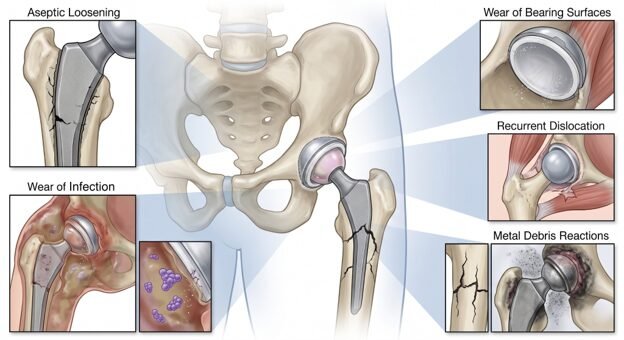
Modern hip implants are reliable, but no prosthesis lasts forever. The causes of long-term failure are well understood.
- Aseptic loosening: The bond between the implant and the bone weakens gradually, allowing the prosthesis to shift inside the joint.
- Wear of bearing surfaces: The plastic, ceramic, or metal surfaces of the implant wear down with use, producing tiny particles that can irritate the surrounding bone.
- Late infection: Bacteria can settle around the implant years after surgery, often spreading from a dental or urinary source.
- Recurrent dislocation: Repeated episodes of the ball slipping out of the socket weaken the soft tissues and may require surgical correction.
- Periprosthetic fracture: A fall or sudden impact can fracture the bone around the implant and disturb its fixation, often calling for expert fracture and trauma care alongside revision surgery.
- Metal debris reactions: Older metal-on-metal implants can release particles that cause swelling, pain, and damage to the surrounding tissues.
The exact cause shapes the surgical plan, which is why detailed imaging and laboratory tests are essential before any revision procedure.
Red Flags: Symptoms That Suggest Your Hip Implant Is Failing
Certain symptoms suggest that an implant is no longer functioning as it should, and these warrant prompt clinical review.
- Persistent groin, thigh, or buttock pain in a previously settled hip.
- A new limp or shortening of the affected leg.
- A clicking, popping, or grinding sound during movement.
- A sensation that the hip is loose, unstable, or about to give way.
- Pain that wakes the patient at night or persists even at rest.
- Reduced walking distance or difficulty performing daily activities.
- Swelling, warmth, or redness around the hip, which may indicate infection.
Experiencing pain in an old hip replacement? Get it assessed before the problem progresses.
Imaging and Lab Tests Used to Investigate a Painful Hip Replacement
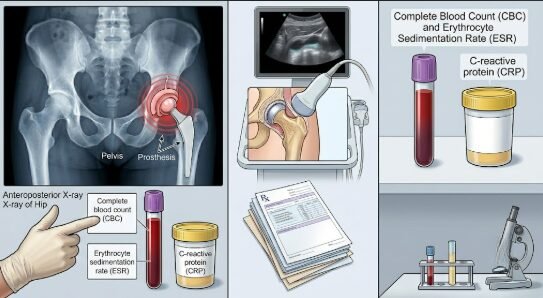
Confirming that a hip replacement has failed requires a combination of clinical assessment, imaging, and laboratory studies.
- Physical examination to check gait, leg length, range of motion, and tenderness around the joint.
- X-rays to look for component loosening, wear, fractures, or osteolysis around the implant.
- CT scan to assess bone loss and the exact position of the prosthesis in detail.
- MRI with metal artifact reduction to evaluate soft tissue, tendons, and fluid collections.
- Blood tests including ESR and CRP to check for raised infection markers.
- Joint fluid aspiration, in which a sample of fluid is drawn from the hip and tested for bacteria.
Together, these findings determine whether revision is required, and if so, whether a single-stage or two-stage procedure is appropriate.
Inside the Operating Theatre: How Revision Hip Surgery Works
Revision hip replacement is a longer and more technically demanding procedure than the primary surgery. It is performed under spinal or general anaesthesia and follows a structured sequence.
- Removal of the failed components: The surgeon carefully removes the loose, worn, or infected parts of the original implant while preserving as much bone as possible.
- Bone preparation and grafting: Damaged bone is cleared and prepared. Bone graft or metal augments may be used to make up for any bone loss around the socket or femur.
- Implantation of revision components: Specialised revision implants, often with longer stems or larger cups, are fitted to restore stability and length.
- Soft tissue and length balancing: The hip capsule and surrounding tissues are adjusted to restore equal leg length and proper joint mechanics.
The hospital stay after revision hip replacement is generally a few days, with mobilisation starting soon after surgery.
First-Time vs Second-Time Hip Replacement: What Changes
Both procedures share the same goal of relieving pain and restoring function, but the two operations differ in several important ways.
| Feature | Primary Hip Replacement | Revision Hip Replacement |
| Purpose | Replace a damaged natural hip | Replace a failed artificial hip |
| Complexity | Standard procedure | Longer, more complex procedure |
| Implants used | Standard prosthesis | Specialised revision implants with longer stems or augments |
| Bone condition | Generally healthy | Often weakened or partly lost |
| Recovery time | Around three months | Longer, often four to six months |
| Risk profile | Low, well established | Higher than primary surgery |
Understanding these differences helps patients plan realistically for the operation and the rehabilitation that follows. Many of the same surgical principles apply to revision knee replacement surgery, where bone loss and component removal present similar challenges.
Life After Revision Hip Surgery: Weeks 1 to 6 Months
Recovery after revision hip replacement is steadier than after the primary procedure. It follows a defined progression over several months.
- Early mobilisation: Walking with a walker or crutches usually starts within one to two days of surgery, with weight-bearing guided by the surgeon.
- Physiotherapy: A structured rehabilitation programme rebuilds hip strength and gradually restores range of motion over several weeks.
- Wound and implant monitoring: Regular follow-up appointments check the surgical site, leg length, and overall recovery.
- Return to daily activity: Most patients resume routine light activities within eight to twelve weeks, depending on the extent of the surgery.
- Long-term care: Long-term joint protection, weight management, and avoiding high-impact activity help the new implant last.
Patience during rehabilitation is essential, as the soft tissues around the hip take longer to heal after revision than after the first operation.
Considering revision hip surgery? A specialist assessment provides a clear treatment plan.
When Hip Pain Cannot Wait: Same-Week Warning Signs
Some symptoms after a hip replacement should not be ignored, as early review prevents further damage to the joint and surrounding bone.
- Sudden onset of severe hip or thigh pain after a fall or injury.
- A new or worsening limp that does not improve within a few days.
- Visible difference in leg length or change in the way the hip sits.
- Fever, chills, or redness around an old surgical scar, which may suggest infection.
- Inability to bear weight on the affected leg.
- Recurrent episodes of the hip slipping out of place.
Patients with a long-standing hip replacement should attend regular follow-up reviews with an experienced orthopedic specialist in Firozabad, even when the hip feels well, so that subtle changes can be picked up early.
Why Choose Dr. Parv Mittal for Revision Hip Replacement in Firozabad?

The complexity of revision hip surgery makes the choice of surgeon especially important.
Dr. Parv Mittal is a trusted orthopedic specialist in Firozabad with M.S. Orthopaedic Surgery, MRCS (UK), and DNB Orthopaedics, supported by over 10 years of experience across reputed hospitals in New Delhi. His expertise in hip replacement surgery and arthroscopy enables him to manage both primary and revision procedures with modern techniques, including robotic-assisted joint surgery where appropriate.
Patients complete the first consultation with a clear understanding of the cause of implant failure and a defined treatment plan, whether that involves a single-stage or two-stage revision. This combination of detailed planning and surgical experience makes him a reliable choice for revision hip replacement surgery in Firozabad.
Protect long-term hip function before further bone loss develops.
Frequently Asked Questions
How long does a hip replacement usually last?
Most modern hip implants last between 15 and 25 years, though younger or more active patients may experience wear sooner.
Is mild hip pain years after replacement always a sign of failure?
Not always, as some pain can come from soft tissue causes such as bursitis or tendon irritation. Persistent or worsening pain, however, should always be assessed.
Can a hip replacement be revised more than once?
Yes, but each subsequent revision is more challenging due to bone loss, so preserving bone during every operation is important.
How long is the recovery after revision hip replacement?
Most patients regain comfortable walking and good function after recovery, though the outcome depends on the cause of failure and the condition of the bone. Book a consultation with Dr. Parv Mittal for an individual assessment of your hip.
Will I be able to walk normally again after revision hip surgery?
Most patients regain comfortable walking and good function after recovery, though the outcome depends on the cause of failure and the condition of the bone. Book a consultation with Dr. Parv Mittal for an individual assessment of your hip.