 English
 हिंदी
हिंदीRobotic Knee Surgery in Firozabad
Knee pain that does not improve after months of physiotherapy, injections, and rest is a signal worth taking seriously. For patients in Firozabad dealing with advanced arthritis or severe joint damage, robotic knee surgery in Firozabad is now accessible without travelling to Delhi or Mumbai. The technology maps your knee in 3D before the first incision and places the implant with sub millimetre accuracy, meaning less tissue damage, faster walking, and a joint that feels natural sooner.
As a specialist in robotic knee replacement in Firozabad, Dr. Parv Mittal brings fellowship trained robotic arthroplasty skills directly to patients in Uttar Pradesh. He prioritises preserving the natural joint, enabling faster rehabilitation, and helping patients return to daily life with better strength and confidence.
The cost of robotic knee surgery depends on several factors specific to your case:
- Severity and extent of knee damage
- Type of implant selected, standard vs premium or imported
- Duration of hospital stay and post surgical care requirements
- Anaesthesia type and surgical complexity
- Whether one or both knees require replacement
Need expert care for your knee pain? Reach out to a specialist for advanced robotic treatment and a personalised recovery plan.
What is Robotic Knee Surgery?
Understanding Robotic Assisted Knee Replacement
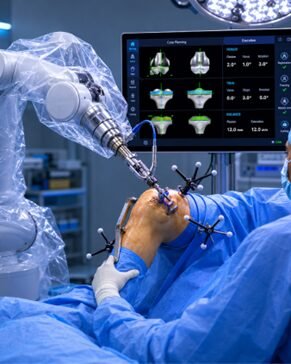
Robotic knee surgery is a minimally invasive procedure where the surgeon uses a computer guided robotic arm to perform knee replacement with greater precision than conventional surgery allows. A CT scan taken before the procedure creates a 3D digital model of the patient’s exact knee anatomy.
The robotic system operates strictly within pre programmed surgical boundaries. It will not allow the surgeon to cut outside the planned zone. Think of it as GPS for the knee joint: the route is mapped in advance, and the system keeps every movement on track during the procedure.
It is commonly used for:
- Total knee replacement due to severe arthritis
- Partial knee replacement for isolated compartment damage
- Complex cases where standard implant positioning carries higher risk
Aware of your symptoms but still unsure about robotic surgery specifically? Here is a clear look at its benefits over conventional approaches.
Benefits of Robotic Knee Surgery
Why Choose Robotic Knee Replacement?
Greater Surgical Precision
the robotic system maps and executes cuts within pre set boundaries, reducing error at the operating table.
Better Implant Positioning
accurate alignment means the implant functions the way a natural knee should, reducing wear over time.
Reduced Tissue Damage
targeted movements mean surrounding muscles and ligaments stay intact during surgery.
Faster Recovery:
most patients are walking the same day or within 24 hours of surgery.
Less Postoperative Pain:
less tissue trauma translates directly to less discomfort in the days that follow.
Improved Mobility:
properly aligned joints move more naturally, something patients notice within the first few weeks.
Better Long Term Results:
implants placed with robotic accuracy last longer and require fewer revision procedures.
Personalised Surgical Planning:
your 3D knee model is built from your own anatomy, not a generic template.
Still comparing robotic and traditional surgery? The table below puts the differences side by side.
Robotic Knee Surgery vs Traditional Knee Replacement
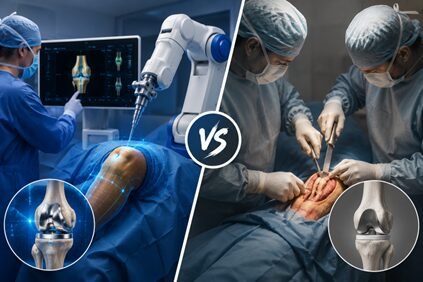
Patients often ask whether robotic knee replacement is genuinely worth it over standard surgery. The comparison below covers the key differences:
| Feature | Robotic Knee Surgery | Traditional Knee Surgery |
| Surgical Precision | Computer guided, patient specific | Manual, surgeon dependent |
| Implant Alignment | Highly accurate, within 1mm | Conventional technique |
| Tissue Preservation | Minimal damage to surrounding tissue | More tissue disruption |
| Pain After Surgery | Reduced postoperative pain | Moderate to high pain |
| Recovery Speed | Faster, walk within hours | Longer rehabilitation |
| Risk of Revision | Lower | Comparatively higher |
| Customisation | 3D pre surgical plan per patient | Standard approach |
Wondering whether your condition requires robotic knee replacement? The next section covers the exact conditions it addresses.
Who Needs Robotic Knee Replacement Surgery?
Conditions Treated with Robotic Knee Surgery
Patients who have not found lasting relief through physiotherapy, injections, or medication are the most common candidates. Dr. Parv Mittal also provides arthroscopy treatment in Firozabad for joint conditions that do not require full replacement, making it easier to match each patient with the right level of intervention.
Osteoarthritis of the Knee
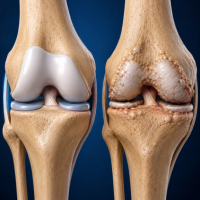
The most common reason patients seek robotic knee surgery. Cartilage breakdown over years causes bone on bone grinding, chronic pain, and swelling that makes even short distances difficult to manage.
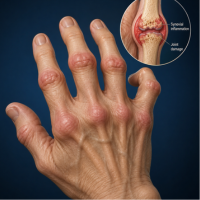
Rheumatoid Arthritis
An autoimmune condition where the lining of the knee joint is chronically inflamed. When medications no longer control the damage, joint replacement becomes the most effective route to lasting relief.
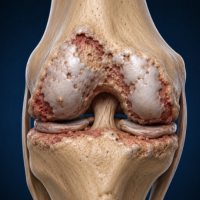
Severe Knee Joint Damage
Post traumatic damage from old fractures, ligament injuries, or worn out cartilage that has not healed well. Robotic surgery handles these complex cases with far greater accuracy than conventional approaches.

Chronic Knee Pain
Pain present for more than six months that has not responded to injections or physiotherapy and is clearly originating inside the joint rather than from surrounding muscles.
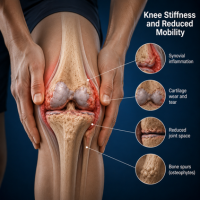
Knee Stiffness and Reduced Mobility
Patients who can no longer bend or straighten the knee fully, making daily activities like climbing stairs or rising from a chair genuinely difficult.

Failed Non Surgical Treatments
When medications, injections, braces, and physiotherapy have all been tried without lasting improvement, robotic knee replacement often becomes the most effective long term solution.
Struggling with chronic knee pain or reduced mobility? Connect with a specialist to find out if robotic knee surgery is right for you.
Symptoms That Indicate You May Need Knee Replacement Surgery
Pay close attention if you recognise any of the following. Each one is worth a consultation with an orthopedic specialist:
- Persistent knee pain that does not ease with rest
- Difficulty walking or developing a limp by mid day
- Pain while climbing stairs or rising from a seated position
- Morning stiffness lasting more than 30 minutes
- Swelling around the knee joint that keeps returning
- Reduced flexibility, unable to fully straighten or bend the knee
- Visible deformity with the knee bowing inward or outward
- Activity limitations affecting work or daily routine
Decided you want to move forward? Here is exactly how the procedure works from consultation to recovery.
How Robotic Knee Surgery is Performed
Step by Step Procedure
Initial Consultation
The surgeon reviews your history, previous X rays or MRIs, and assesses how significantly the knee is affecting your daily routine. This conversation shapes the entire treatment plan.
Knee Evaluation and Imaging
A CT scan creates a digital 3D map of your knee, capturing the exact shape, angle, and dimensions of your joint. This becomes the foundation for the surgical plan.
Robotic Surgical Planning
Before you enter the operating room, every bone cut and implant placement is planned on the 3D model. The surgical boundaries are programmed into the robotic system so there is no deviation during the procedure.
Precision Knee Implant Placement
During surgery the robotic arm guides the surgeon through each step. The implant is placed exactly where the pre surgical plan dictated. No guesswork, no manual estimation.
Post Surgery Recovery and Rehabilitation
A structured physiotherapy programme begins almost immediately, often the same day as surgery. Pain is managed with targeted medication and follow up appointments track progress across the first three months.
Want to know what makes Dr. Parv Mittal the right choice for this procedure in Firozabad?
Why Choose Dr. Parv Mittal for Robotic Knee Surgery in Firozabad?

Dr. Parv Mittal holds an MS in Orthopaedic Surgery, MRCS (UK), and DNB Orthopaedics. He completed a fellowship in robotic assisted knee and hip arthroplasty at Tan Tock Seng Hospital Singapore, one of Asia’s leading orthopaedic training centres. Patients in Firozabad access that level of training locally without travelling to a metro city.
Beyond robotic knee replacement, Dr. Mittal also manages fracture and trauma treatment in Firozabad, covering the full spectrum of orthopedic care from acute injuries to complex joint reconstruction under one roof.
Credentials:
- MS Orthopaedic Surgery, MRCS (UK), DNB Orthopaedics
- Fellowship in Robotic Assisted Knee and Hip Arthroplasty at Tan Tock Seng Hospital Singapore
- Fellow in Hip and Knee Arthroplasty at Sant Parmanand Hospital New Delhi
- International conference presenter in joint replacement and arthroscopy research
- Specialisation in arthroplasty, sports medicine, and complex joint reconstruction
Need dependable knee care in Firozabad? Reach out to Dr. Parv Mittal for a precise diagnosis and a treatment plan built around your condition.
Recovery After Robotic Knee Replacement Surgery
How Long Does Recovery Take?
Recovery after robotic knee surgery is faster and more predictable than conventional knee replacement. Here is roughly what to plan for:
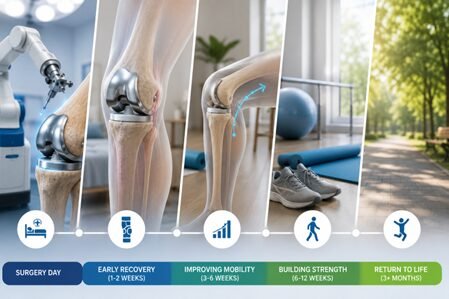
Day 1 to 2:
Standing and walking with support. Physiotherapy begins in hospital.
Week 1 to 2:
Discharged home, walking with a frame. Light exercises continue daily.
Week 4 to 6:
Most patients walk unaided or with minimal support.
Month 2 to 3:
Return to normal daily activities. Office work and driving typically resume.
Month 6:
Full recovery for most patients. High impact activities after surgeon clearance.
Pain management is active throughout, not just medication but physiotherapy targeting the muscles that support the joint. Follow up imaging at six weeks confirms the implant is settling correctly.
Cost of Robotic Knee Surgery in Firozabad
The cost of robotic knee surgery depends on several factors specific to your case:
- Severity and extent of knee damage
- Type of implant selected, standard vs premium or imported
- Duration of hospital stay and post surgical care requirements
- Anaesthesia type and surgical complexity
- Whether one or both knees require replacement
Frequently Asked Questions
Is robotic knee surgery safe?
Yes. The robotic system operates strictly within pre programmed limits, which reduces the risk of accidental damage to nerves, vessels, or surrounding tissue compared to fully manual techniques. It has a strong safety record across thousands of procedures globally.
How soon can I walk after surgery?
Most patients stand and take supported steps within 4 to 8 hours of the procedure. Walking with a support frame typically begins on the same day as surgery.
Is robotic knee surgery better than traditional surgery?
For most patients with arthritis or significant joint damage, yes, particularly in terms of implant longevity and early recovery. Implant alignment is more accurate, which directly reduces wear and the likelihood of a revision procedure years later.
How long does full recovery take?
Basic mobility returns within days. Full recovery, where you are back to all normal activities, generally takes 3 to 6 months depending on age, fitness level, and how far arthritis had progressed before surgery.
How long does a knee implant last?
Modern implants placed with robotic accuracy are designed to last 20 to 25 years in most patients. Proper alignment, the main advantage of robotic surgery, significantly reduces the wear that shortens implant life in conventional procedures.