
 English
 हिंदी
हिंदी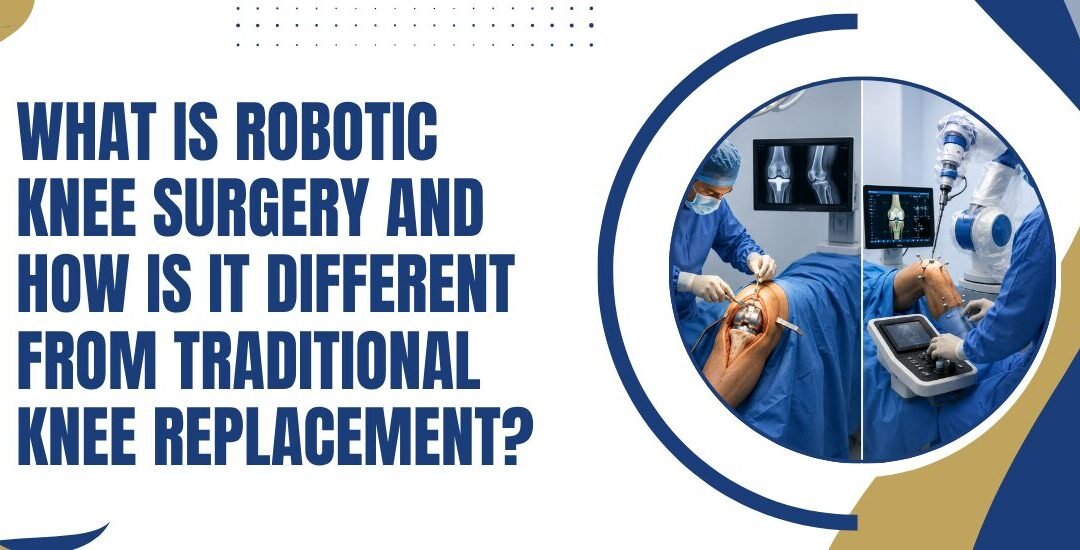
Robotic knee surgery uses a computer guided arm that helps the surgeon plan and place the implant with a level of precision the human hand alone can’t consistently match. Data comparing the two approaches shows robotic assisted replacements land closer to ideal mechanical alignment, with noticeably fewer outliers falling outside the safe range. Traditional replacement still works the way it always has, built on manual instruments, X-ray based planning and the surgeon’s direct judgment in the moment. Neither approach changes what the implant is. It changes how precisely that implant gets seated.
According to Dr. Parv Mittal, orthopedic doctor in Firozabad, “Patients often assume robotic means a robot is doing the surgery. It doesn’t. I’m still making every decision and every cut. The arm just keeps me inside the plan we’ve already mapped on the patient’s own anatomy, down to a fraction of a millimeter. That’s the real difference.
How Does Robotic Assisted Knee Surgery Actually Work?
It’s not one machine doing one job. It’s a sequence, each step feeding into the next.
3D Planning Before the Cut: A CT scan builds a digital model of your knee before you’re anywhere near the operating table. The surgeon studies your bone shape, joint angle and ligament tension on that model first. Nothing about your anatomy is guessed at.
Sub Millimeter Precision: The robotic arm keeps the surgeon’s cuts inside the plan, flagging deviation before it happens. That’s a tighter margin than freehand instrumentation typically allows.
Real Time Feedback: Sensors track ligament tension as the joint moves through the procedure. Loose here, tight there, the system catches it live. Adjustments happen mid surgery, not after.
Surgeon Still in Control: The arm doesn’t cut on its own. It stops the surgeon from stepping outside the boundary already set. Think guardrails, not autopilot.
Understanding what robotic knee surgery actually involves is the first real step before deciding if it’s right for you. It’s a precision tool, not a substitute for surgical judgment.
Robotic Knee Surgery vs Traditional Knee Replacement: What Actually Changes?
Feature | Robotic Knee Surgery | Traditional Knee Replacement |
Planning | 3D CT based model built before surgery | X ray based, measured manually |
Precision | Sub millimeter guided placement | Depends on surgeon’s manual technique |
Soft Tissue Handling | Real time ligament tension feedback | Judged visually during the procedure |
Recovery Trend | Slightly favorable in several cohort studies | Decades of well documented outcomes |
Surgery Duration | Often 15 to 30 minutes longer | Typically shorter, no scan mapping step |
Planning Makes the First Difference: A digital model built before the operation removes a layer of guesswork that manual planning has always carried. You’re not adjusting mid surgery to fit an estimate.
Precision Isn’t Just a Buzzword: Alignment outliers are measurably fewer with robotic guidance. That doesn’t mean every patient needs it. It means the margin for error shrinks.
Soft Tissue Handling Is Where It Gets Interesting: Ligament balance affects how natural the knee feels years later. Real time feedback catches imbalance the eye alone might miss.
Recovery Data Is Still Catching Up: Short term outcomes look comparable, sometimes marginally better with robotic assistance. Long term data is still being built. Traditional technique has decades behind it. That’s not a weakness. That’s just where the evidence currently stands.
If you’re weighing a different joint decision altogether, this breakdown of arthroscopy versus open surgery covers similar ground on minimally invasive choices.
Curious if robotic assisted knee replacement fits your case?
Why Choose Dr. Parv Mittal for Robotic Knee Surgery?
Dr. Parv Mittal brings over ten years of orthopedic experience across reputed hospitals in New Delhi, with a specific focus on arthroplasty and sports medicine. He completed a dedicated fellowship in robotic assisted knee and hip arthroplasty at Tan Tock Seng Hospital, Singapore, training directly on the systems now used in Firozabad. His approach starts with the 3D surgical plan built around each patient’s own anatomy, not a generic template applied across the board. Complex cases get reviewed and cross checked before the surgical date, not decided in the moment. That combination, specific robotic training paired with a planning first mindset, is exactly why precision stays the priority rather than becoming a marketing line.
Every robotic case still comes down to clinical judgment, never the machine running the show. Patients get a plan built for their own knee, not a standard implant size pulled off a shelf. Fewer alignment outliers generally means less strain on the joint in the years that follow. Call +91 99908 48807 to book your consultation.

Frequently Asked Questions
Is robotic knee surgery safer than traditional knee replacement?
Not necessarily safer, but generally more precise in implant alignment and positioning.
Does robotic surgery mean a robot performs the operation?
No. The surgeon operates throughout; the arm assists with precision guidance only.
How much longer does robotic knee surgery take?
Usually 15 to 30 minutes longer due to scanning and plan mapping.
Is robotic knee replacement suitable for all patients?
Most candidates for standard knee replacement qualify; your surgeon confirms suitability first.
Disclaimer:
This blog is for educational purposes and doesn’t replace professional medical advice. If persistent knee pain sounds familiar, please see a qualified orthopedic surgeon for evaluation.